November 6, 2026 | Electronics Manufacturing & Industry Intelligence
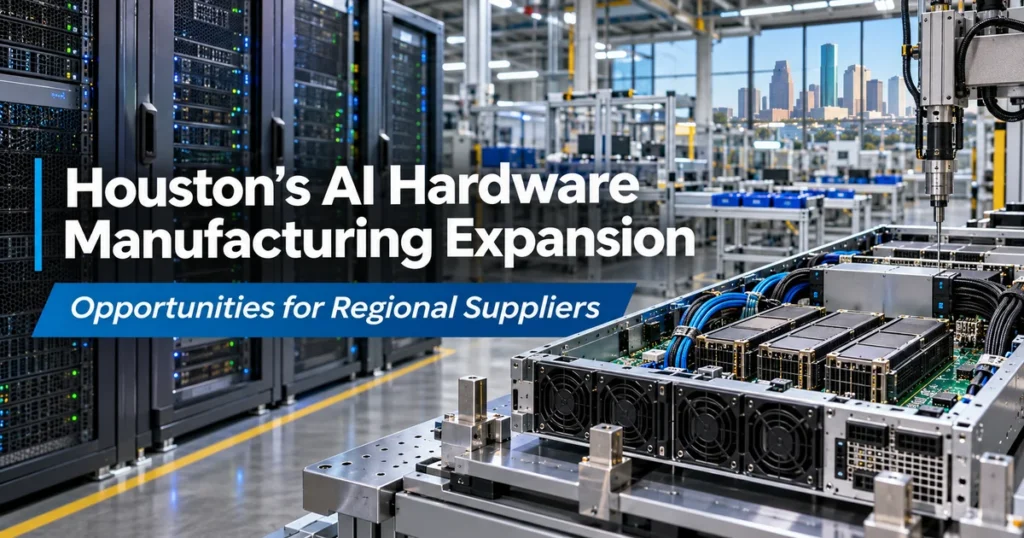
Houston has traditionally been recognized for its energy, petrochemical, and industrial manufacturing industries. However, growing investments in artificial intelligence infrastructure are helping expand the region’s role in advanced electronics manufacturing.
On October 30, 2026, Foxconn Chairman Young Liu confirmed that the company operates six AI-server manufacturing factory buildings in Houston and sees a need for additional expansion.
Foxconn, formally known as Hon Hai Precision Industry, is one of the world’s largest electronics contract manufacturers and a major producer of NVIDIA AI servers.
The announcement comes as demand for advanced computing infrastructure continues to drive investment in manufacturing facilities, production equipment, and related technologies.
For regional manufacturers and suppliers, this development raises an important question: Could Houston’s growing AI hardware industry create additional opportunities for companies providing precision components, cable assemblies, manufacturing equipment, and integration services?
While opportunities may develop, suppliers must distinguish between confirmed facility investments and potential future manufacturing requirements.
Foxconn Signals Additional AI-Server Manufacturing Growth in Houston
According to an October 30 Reuters report, Foxconn Chairman Young Liu stated that the company’s six Houston factory buildings manufacture AI servers for NVIDIA.
Liu indicated that further expansion would be needed, although the company did not announce a specific new Houston facility investment or construction schedule during those remarks.
The announcement reflects the growing importance of AI infrastructure to Foxconn’s overall business.
In August 2026, Foxconn reported that its cloud and networking products segment, which includes AI servers, represented 51% of the company’s second-quarter revenue.
That marked the first time the segment exceeded half of its quarterly revenue.
The growth of AI-related manufacturing highlights how demand for computing infrastructure is becoming an increasingly important factor in global electronics production.
For Houston, Foxconn’s continued presence adds another dimension to an industrial market already supported by established engineering, fabrication, logistics, and manufacturing capabilities.
A $71.9 Million Houston Manufacturing Renovation
Separate from Foxconn’s October 30 statements, a filing with the Texas Department of Licensing and Regulation documents a substantial renovation project at an existing Houston facility.
The project, registered July 16, 2026, is located at:
8718 Fairbanks North Houston Road, Suites 200 and 300, Houston, Texas 77064.
The filing identifies:
- Project name: Foxconn – Office, Production & Breakroom
- Estimated construction cost: $71,909,878
- Project size: 74,312 square feet
- Project type: Renovation and alteration
- Scheduled construction start: September 1, 2026
- Scheduled completion: January 29, 2027
- Property owner: Ingrasys Technology USA Inc.
According to the project description, the work involves remodeling an existing shell building to create office, production, and breakroom areas.
The regulatory filing provides documented evidence of manufacturing-related facility investment in Houston.
However, it does not specify which products will be manufactured in the renovated space, identify a particular customer program, or confirm that the renovation represents the additional expansion discussed by Liu on October 30.
The reported $71.9 million is an estimated construction cost, not a disclosed equipment purchase budget or supplier contract value.
Foxconn and OpenAI Discuss Additional Collaboration
Another development emerging from Foxconn’s October 30 announcements involves a possible expansion of its relationship with OpenAI.
According to Reuters, Liu indicated that he had met with OpenAI CEO Sam Altman and that discussions regarding another collaboration were underway.
The potential arrangement would build on a previously announced 2025 relationship involving the design and engineering of data-center racks, components, and other AI-related hardware.
However, no new agreement details, purchase orders, or manufacturing commitments were announced on October 30.
For the manufacturing industry, the discussions illustrate continued interest in the infrastructure required to operate increasingly demanding AI computing systems.
These systems involve more than semiconductor devices alone. They also require electrical distribution, mechanical structures, thermal management, interconnects, networking equipment, and manufacturing verification.
Any additional agreements could have implications for the broader supply chain, but specific sourcing opportunities cannot be established until confirmed manufacturing requirements become available.
What AI-Server Manufacturing Requires Beyond Semiconductor Chips
AI servers represent complex electronic systems containing numerous manufactured components and interconnected assemblies.
Although the processors receive much of the attention, the supporting hardware and manufacturing processes are equally important to building a complete system.
Several capability areas are particularly relevant to the industry.
1. Cable Assemblies and Interconnect Solutions
Advanced server systems require reliable electrical and signal connections between internal components, power systems, and external infrastructure.
Depending on the system architecture, manufacturers may require:
- Custom power cable assemblies
- Internal cable harnesses
- High-speed signal interconnects
- Power distribution connections
- Cable routing and retention components
- Application-specific connector solutions
These assemblies must be designed and manufactured to meet appropriate electrical, mechanical, and reliability requirements.
For regional cable and interconnect manufacturers, growing AI hardware production may create opportunities to support specialized requirements, provided the suppliers meet the applicable technical, qualification, and commercial standards.
2. Precision Machining and Mechanical Components
AI infrastructure also depends on mechanically engineered hardware.
Server racks, cooling systems, automation equipment, and production fixtures may incorporate:
- CNC-machined brackets and support structures
- Precision mounting components
- Custom equipment fixtures
- Aluminum and steel enclosures
- Mechanical adapters
- Tooling and assembly aids
Many of these components require consistent dimensional accuracy and repeatable manufacturing processes.
For precision machining companies, the relevant opportunity may not be manufacturing the complete server system. It may involve supplying specialized components or fixtures used in production, installation, or maintenance.
3. PCB Assembly and Electronic Integration
Modern computing equipment contains numerous printed circuit board assemblies beyond the main processing hardware.
Examples can include power management boards, monitoring electronics, control interfaces, and supporting communication circuitry.
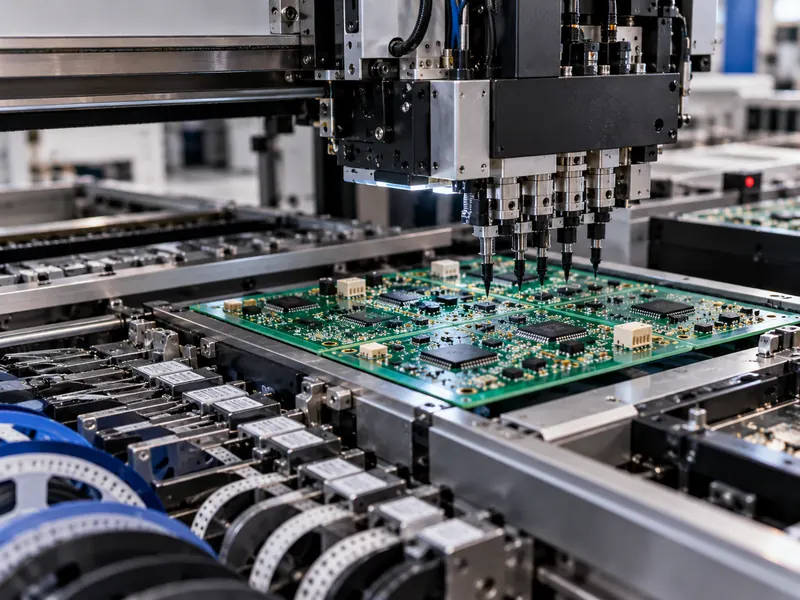
Manufacturing these assemblies can require surface-mount technology, inspection, functional testing, and quality documentation.
However, the presence of PCB assemblies in AI servers does not establish that Foxconn intends to outsource their production.
Foxconn maintains extensive internal manufacturing and engineering capabilities, so external suppliers would need to demonstrate a specific technical or commercial advantage.
4. Manufacturing Test Equipment and Production Support
Increasing production capacity typically requires corresponding investments in inspection, assembly verification, and test processes.
Depending on the application, supporting equipment may include:
- Automated test fixtures
- Mechanical inspection fixtures
- Electrical test interfaces
- Assembly tooling
- Custom test cable assemblies
- Production handling equipment
For specialized manufacturers, these supporting production requirements may present a different market opportunity from supplying components incorporated into finished server products.
Automation Is Also Becoming Part of Houston’s AI Manufacturing Story
Foxconn’s Houston operations are also drawing attention for their adoption of manufacturing automation.
Reuters reported on October 30 that Foxconn Industrial Internet had deployed more than ten humanoid robots at Texas facilities for internal use.
The company also discussed robotic systems designed to support activities such as assembly, material movement, and loading or unloading operations.
While the scale of these deployments remains limited relative to overall factory production, they demonstrate the company’s interest in exploring additional automation methods.
For the regional manufacturing community, increased automation may influence demand for production tooling, fixtures, mechanical components, controls, and equipment integration.
Any resulting supplier opportunities would depend on actual project requirements and purchasing decisions.
What Houston’s Expansion Could Mean for Regional Suppliers
Houston already supports a substantial industrial manufacturing ecosystem with experience serving demanding applications.
Many companies in the region provide CNC machining, electronics assembly, industrial fabrication, cable manufacturing, and engineered components.
These existing capabilities may be relevant to advanced computing infrastructure, although requirements differ significantly between industries.
For example, a supplier accustomed to manufacturing oilfield components may possess useful machining expertise but still need to qualify its processes, materials, documentation, and production capacity for electronics infrastructure applications.
Similarly, an electronics manufacturing company may have PCB assembly experience but require additional capabilities to support the thermal, electrical, or high-speed signal requirements of certain AI systems.
The opportunity is not simply that more AI servers are being manufactured in Houston. It is that continued investment may create new requirements across a broader network of equipment and component suppliers.
Whether those requirements become accessible to independent regional manufacturers will depend on how Foxconn and its partner structure their supply chains.
Five Ways Regional Manufacturers Can Prepare
Manufacturers interested in serving the growing AI hardware industry should focus on measurable capabilities rather than assuming local expansion will automatically produce business.
1. Identify relevant manufacturing capabilities
Determine which existing services align with data-center equipment, power systems, mechanical infrastructure, or production support.
2. Evaluate technical requirements
Review applicable drawings, tolerances, material specifications, inspection requirements, and production documentation before pursuing new work.
3. Prepare clear capability information
A concise capability statement should explain manufacturing processes, production volumes, equipment, quality systems, and relevant experience.
4. Research established supply chain relationships
Large electronics manufacturers often operate through approved supplier programs and existing sourcing networks. Identifying appropriate procurement or engineering contacts is more effective than making broad assumptions about outsourcing.
5. Monitor confirmed investments and purchasing activity
Track facility construction, equipment installations, supplier qualification programs, and publicly announced partnerships.
These activities can provide more actionable information than general industry growth projections alone.
What Should Manufacturers Watch Next?
Several developments could help clarify the direction of Houston’s AI hardware manufacturing sector.
First, Foxconn may provide additional details about the scale and schedule of its planned Houston expansion.
Second, progress on the Fairbanks North Houston Road renovation could provide insight into the region’s growing manufacturing infrastructure.
Third, additional information regarding a possible Foxconn–OpenAI collaboration could establish whether new manufacturing programs or infrastructure requirements are planned.
Finally, ongoing investment in automated manufacturing may create opportunities for specialized equipment and component suppliers.
None of these developments guarantees new external purchasing opportunities, but they provide useful indicators for manufacturers evaluating the regional market.
Final Outlook: Houston’s Manufacturing Base Is Evolving
Foxconn’s comments about expanding AI-server manufacturing reinforce Houston’s growing participation in advanced electronics production.
The company’s existing factory operations, documented facility renovation, and continuing investment in AI-related manufacturing illustrate the scale of activity developing in the region.
For regional suppliers, the most practical response is to understand where their existing manufacturing capabilities may fit.
Cable assemblies, precision machining, mechanical integration, electronics manufacturing, and production support all contribute to complex industrial systems.
Companies that understand the relevant technical requirements, maintain reliable quality processes, and develop appropriate industry relationships may be positioned to evaluate opportunities as the market evolves.
The coming months should provide additional information about Foxconn’s expansion plans and the wider development of Houston’s AI hardware manufacturing ecosystem.
Supporting Advanced Manufacturing and Industrial Supply Chains
Trident Industries works with manufacturing partners to support a range of electronics and mechanical manufacturing requirements, including:
- PCB assembly and electronics manufacturing
- Cable and wire harness assemblies
- Custom connectors and interconnect solutions
- Precision CNC machining
- Castings and forgings
- Mechanical assembly and system integration
We help customers evaluate manufacturing options based on their technical requirements, production needs, and supply chain considerations.
Have a project requiring electronics manufacturing, precision components, or custom assemblies?
Sources
- Reuters — Foxconn Working on a New Tie-Up With OpenAI (October 30, 2026)
- Texas Department of Licensing and Regulation — Project TABS2026025427
Editorial note: Statements regarding potential manufacturing opportunities are industry analysis. No Foxconn purchasing commitment, supplier qualification opportunity, or new OpenAI manufacturing contract is implied.