November 9, 2026 | Manufacturing & Supply Chain Intelligence
For years, original equipment manufacturers (OEMs) have relied on overseas production to reduce manufacturing costs and access established supply chains. However, changing trade policies, geopolitical uncertainty, and concerns about supplier reliability are causing more companies to reconsider where their products are manufactured.
New research from the Reshoring Initiative suggests that interest in bringing manufacturing back to the United States continues to grow.
According to the organization’s October 23, 2026 annual report, U.S. manufacturers and foreign investors announced approximately 247,000 manufacturing jobs through reshoring and foreign direct investment during 2025.
The organization also projects approximately 309,000 announced manufacturing jobs for 2026, representing a potential increase of 25%.
While these figures reflect announced employment rather than jobs already created, they demonstrate continued interest in expanding domestic manufacturing capacity.
For OEMs evaluating electronics manufacturing, precision machining, cable assemblies, and other outsourced production services, the findings highlight an important development: more companies are exploring U.S.-based manufacturing alternatives.
U.S. Contract Manufacturers Are Seeing More Reshoring Inquiries
One of the more notable findings involves the growing number of contract manufacturers quoting reshoring projects.
The Reshoring Initiative’s October 2026 report indicates that the share of contract manufacturers quoting reshoring opportunities increased from approximately 16% in 2025 to 33% in 2026.
That represents a significant increase in sourcing activity.
The organization’s earlier 2026 survey release reported a comparable figure of 32%, reinforcing the broader trend.
In addition, 79% of surveyed contract manufacturers indicated that at least some customers had discussed reshoring during the previous year.
The survey included 249 manufacturing companies, consisting of 118 OEMs and 131 contract manufacturers.
These results suggest that domestic manufacturing is becoming a more frequent consideration during supplier evaluations and purchasing discussions.
However, an important distinction remains.
Requesting a quotation does not mean a company has committed to transferring production.
A manufacturer may evaluate several domestic suppliers before deciding whether reshoring is technically feasible, financially competitive, or operationally practical.
For contract manufacturers, increased quotation activity represents potential business opportunities, but converting those opportunities into production programs will depend on pricing, quality, capabilities, and delivery performance.
Why Are OEMs Reconsidering Overseas Manufacturing?
The decision to manufacture domestically involves more than comparing unit prices.
While offshore manufacturing may still offer substantial cost advantages, companies are increasingly evaluating the broader risks and expenses associated with international supply chains.
Several considerations are driving this reassessment.
1. Tariffs and Trade Policy Uncertainty
Import duties can significantly affect the landed cost of manufactured products.
For companies sourcing electronic assemblies, machined components, castings, and other industrial products overseas, changes in tariff classifications or duty rates can alter purchasing economics.
The challenge is not limited to the amount of a particular tariff.
Uncertainty surrounding future trade policy makes it more difficult to establish reliable long-term pricing and sourcing strategies.
According to the Reshoring Initiative’s 2026 survey, 57% of OEM respondents identified policy uncertainty as their primary challenge in the current U.S. trade environment.
For manufacturers working under annual pricing agreements or long-term production contracts, unpredictable import costs can complicate financial planning.
2. Supply Chain Reliability
International sourcing often involves extended transportation routes, customs clearance, and coordination across multiple suppliers.
When unexpected disruptions occur, manufacturers may experience delivery delays, material shortages, or increased transportation expenses.
Domestic manufacturing can offer certain advantages, particularly when suppliers and customers operate within the same region.
Potential benefits include shorter transportation distances, improved communication, and greater visibility into production schedules.
However, domestic sourcing does not automatically eliminate supply chain risk.
A U.S.-based contract manufacturer may still depend on imported semiconductors, raw materials, connectors, or specialized components.
OEMs should therefore evaluate the complete supply chain rather than focusing exclusively on the location of final assembly.
3. Faster Engineering and Production Coordination
Product development frequently involves engineering changes, prototype revisions, and adjustments to manufacturing requirements.
Working with a domestic supplier may simplify communication between engineering, purchasing, and production teams.
For electronics manufacturing, this can be particularly useful during prototype builds, new product introduction, and early production ramp-ups.
Engineering teams may need to review PCB assembly requirements, component substitutions, inspection results, or test procedures before releasing a product into volume production.
Closer coordination can help address these requirements more efficiently.
4. Quality and Manufacturing Oversight
Quality expectations are another important consideration when evaluating manufacturing locations.
Depending on the product and industry, OEMs may require documented inspection processes, material traceability, functional testing, and adherence to specific quality standards.
Domestic suppliers may provide easier access for factory visits, production reviews, and engineering discussions.
However, manufacturing location alone does not establish quality.
OEMs should verify a supplier’s actual manufacturing processes, certifications, technical capabilities, and quality performance before awarding production.
What Reshoring Means for Electronics Manufacturing
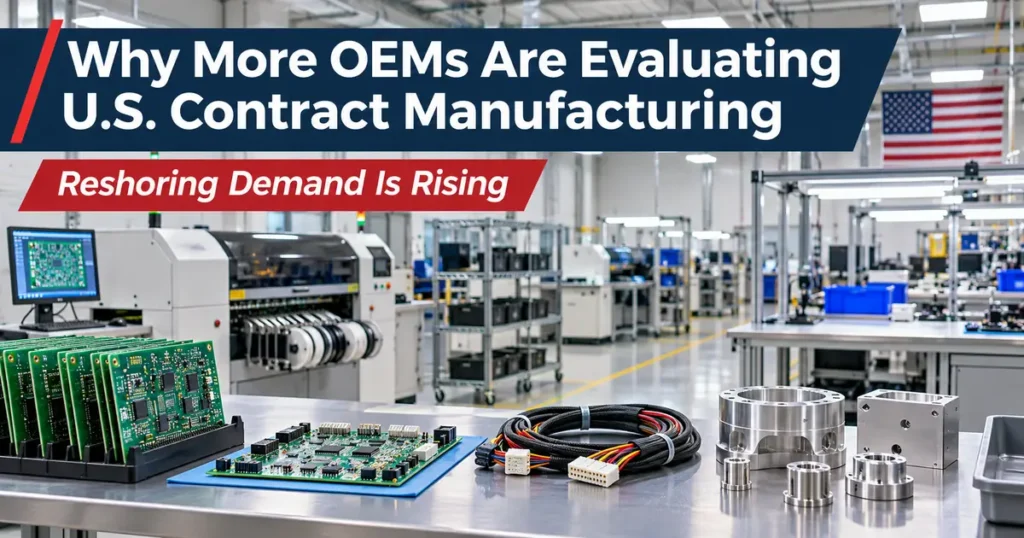
The growing interest in U.S. contract manufacturing has potential implications for companies requiring printed circuit board assembly, cable and wire harnesses, box-build integration, and related manufacturing services.
Electronics manufacturing involves a network of suppliers and processes that must operate together to deliver a finished product.
For an OEM considering domestic production, several factors deserve attention.
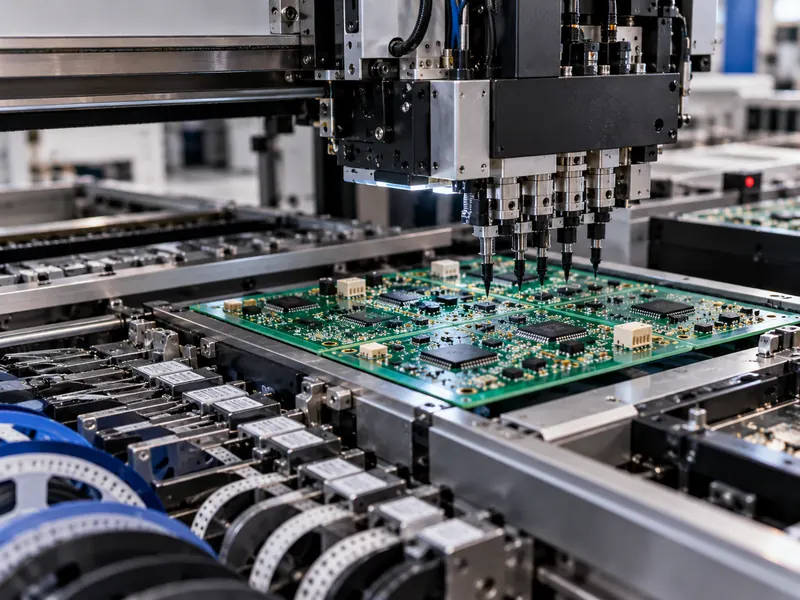
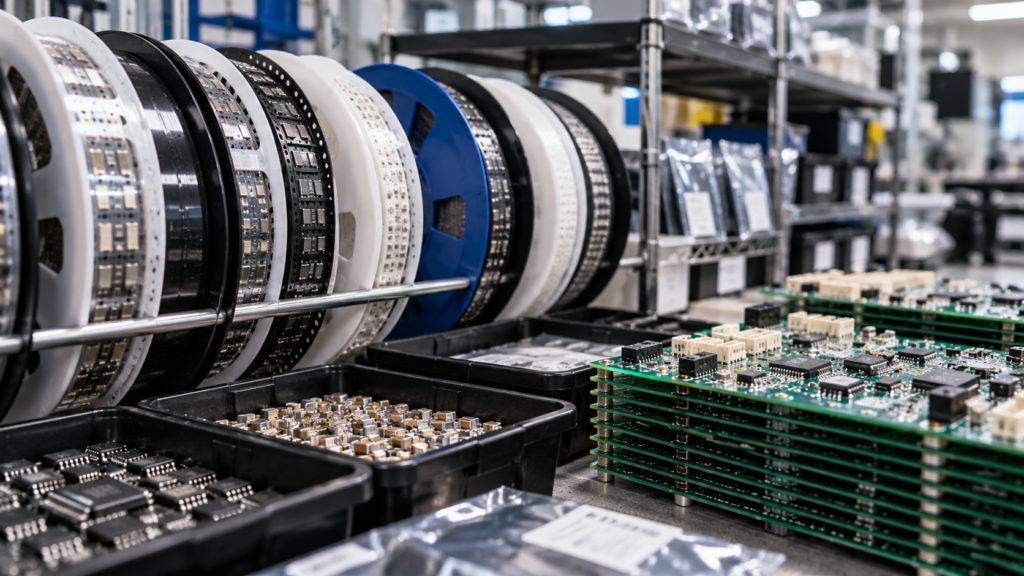
Printed Circuit Board Assembly
Printed circuit board assemblies are used in industrial controls, medical devices, communications equipment, energy systems, and numerous other electronic products.
When evaluating a domestic electronics manufacturing services (EMS) provider, OEMs should consider:
- Surface-mount and through-hole assembly capabilities
- Experience with the required component technologies
- Prototype and production volume flexibility
- Inspection and testing requirements
- Material sourcing and inventory management
- Production documentation and traceability
- Engineering support during product introduction
The objective should be to identify a manufacturing partner capable of supporting the product’s requirements throughout its production life cycle.
Cable and Wire Harness Manufacturing
Many electronic products require custom cable assemblies or wiring harnesses to connect internal components, power systems, sensors, and external equipment.
For OEMs evaluating domestic alternatives, cable and harness manufacturing may offer opportunities to reduce transportation complexity and improve engineering coordination.
Important considerations include connector availability, wire specifications, testing requirements, production volumes, and assembly documentation.
Box-Build and System Integration
Some manufacturers may benefit from outsourcing complete electronic assemblies rather than coordinating multiple suppliers independently.
Box-build manufacturing can involve integrating printed circuit boards, cable assemblies, enclosures, connectors, and mechanical components into a finished product.
Depending on the project, a manufacturing partner may also provide inspection, functional testing, packaging, and shipment preparation.
For OEMs seeking to simplify supply chain management, this approach may reduce the number of separate production activities requiring direct coordination.
Precision Machining and Mechanical Components
Reshoring is not limited to electronics.
Industrial equipment manufacturers also depend on precision-machined components, castings, forgings, fabricated structures, and custom enclosures.
When evaluating domestic mechanical manufacturing suppliers, companies should review production capacity, dimensional tolerances, materials, tooling requirements, inspection capabilities, and overall delivered cost.
The appropriate sourcing decision will depend on the specific component and manufacturing process.
The True Cost of Manufacturing: Looking Beyond Unit Price
One of the most important findings in the Reshoring Initiative’s research involves the growing use of total cost of ownership analysis.
According to the October report, 40% of surveyed OEMs used this approach in 2026, compared with 30% in 2025.
Total cost of ownership evaluates the broader financial impact of sourcing decisions rather than relying solely on the quoted manufacturing price.
For example, consider an OEM comparing two potential suppliers.
An overseas manufacturer may offer a lower initial unit price, but the final cost can also include international freight, applicable duties, insurance, inventory carrying costs, and additional logistics expenses.
A domestic supplier may quote a higher unit price while offering shorter transportation routes, more flexible scheduling, or lower inventory requirements.
Neither option is automatically less expensive.
The appropriate comparison depends on the complete landed cost, operational requirements, and risks associated with each supplier.
For OEMs evaluating reshoring, this broader analysis can provide a more realistic understanding of potential benefits and tradeoffs.
The Challenges Facing U.S. Manufacturing
Despite growing reshoring interest, several obstacles continue to affect domestic manufacturing competitiveness.
Labor Availability
Skilled labor shortages remain a significant concern.
Electronics manufacturing and precision machining depend on trained technicians, machine operators, engineers, quality personnel, and production specialists.
Expanding domestic manufacturing capacity requires continued investment in workforce development and training.
Manufacturing Costs
U.S. manufacturers may face higher labor, facility, and operating costs than certain overseas competitors.
In some applications, automation and improved production efficiency can help reduce these differences.
However, domestic production must still make financial sense for the product and market being served.
Supplier Qualification
Moving an established production program to a new supplier can require substantial planning.
Depending on the product, the transition may involve reviewing technical documentation, validating manufacturing processes, qualifying materials, producing initial samples, and completing customer approval requirements.
OEMs should account for these activities when estimating the cost and schedule of a reshoring project.
Are Manufacturing Jobs Actually Returning?
The Reshoring Initiative’s employment figures require careful interpretation.
The approximately 247,000 manufacturing jobs reported for 2025 represent announced jobs associated with reshoring and foreign direct investment.
They do not represent a verified count of people already hired or new positions already operating in established factories.
Similarly, the organization’s projection of approximately 309,000 announced jobs for 2026 remains a forecast based on information available during the year.
Actual employment and production activity may develop over several years as projects move through construction, equipment installation, hiring, and manufacturing qualification.
The research nevertheless provides evidence that businesses continue to explore and announce domestic manufacturing investments.
For contract manufacturers, the more immediate indicator may be increased customer inquiries and requests for quotation.
Five Questions OEMs Should Ask Before Reshoring Production
For companies considering a move to U.S.-based manufacturing, a structured evaluation can help identify the most practical sourcing strategy.
1. What is the actual total cost of the current supply chain?
Include manufacturing, freight, tariffs, inventory, logistics, and other relevant costs.
2. Can a domestic supplier meet the technical requirements?
Evaluate equipment capabilities, manufacturing processes, quality standards, and production experience.
3. What materials will still require international sourcing?
Domestic assembly does not necessarily mean every component or raw material is manufactured in the United States.
4. What will the supplier transition require?
Consider tooling, engineering documentation, product qualification, inventory transfers, and production validation.
5. Does the domestic supplier support long-term production needs?
Review capacity, responsiveness, financial stability, and the ability to scale production as demand changes.
These questions can help OEMs avoid making sourcing decisions based solely on tariffs or geographic location.
What Should Manufacturers Expect in 2027?
The Reshoring Initiative’s findings suggest that domestic manufacturing will remain an important consideration for OEMs entering 2027.
The 2026 survey found that 63% of OEM respondents planned U.S. capital expenditures during 2026 or 2027 to support reshoring or other domestic expansion.
However, planned investment does not guarantee that every proposed facility, production transfer, or supplier relationship will move forward.
Manufacturers will continue balancing domestic production opportunities against labor costs, technical requirements, supplier availability, and changing trade conditions.
For contract manufacturers, the priority should be demonstrating measurable value through manufacturing capabilities, quality, delivery, and competitive total cost.
Final Outlook: Reshoring Creates Opportunity, but Execution Matters
The latest Reshoring Initiative research indicates that more OEMs are evaluating U.S. manufacturing alternatives.
Increased quotation activity among contract manufacturers suggests that domestic suppliers are receiving greater consideration during sourcing decisions.
However, reshoring is not a simple matter of moving production from one country to another.
Successful transitions require careful planning, supplier qualification, technical coordination, and a clear understanding of manufacturing costs.
For electronics and industrial manufacturers, the opportunity lies in providing practical solutions that help customers improve reliability, maintain quality, and manage their supply chains effectively.
As more OEMs evaluate domestic sourcing, qualified U.S. manufacturing partners may play an increasingly important role in supporting those decisions.
Evaluating U.S. Contract Manufacturing Options?
Trident Industries works with manufacturing partners to support customers requiring:
- Printed circuit board assembly
- Cable and wire harness manufacturing
- Box-build and electronic system integration
- PCB fabrication
- Custom connectors and interconnect solutions
- CNC machining and precision components
- Castings, forgings, and mechanical assemblies
Whether you’re developing a new product, evaluating alternative suppliers, or considering domestic manufacturing options, Trident can help identify manufacturing capabilities aligned with your project requirements.
Contact Trident Industries to discuss your next manufacturing project.
Sources
- Reshoring Initiative — 2025 Annual Report Announcement, October 23, 2026
- Reshoring Initiative — 2026 USA Reshoring Survey Release
- Modern Distribution Management — U.S. Reshoring Job Announcements and 2026 Outlook, October 29, 2026
Editorial note: Manufacturing implications and sourcing recommendations reflect industry analysis. Reported job figures refer to announced employment, and 2026 projections are forecasts rather than confirmed outcomes.