
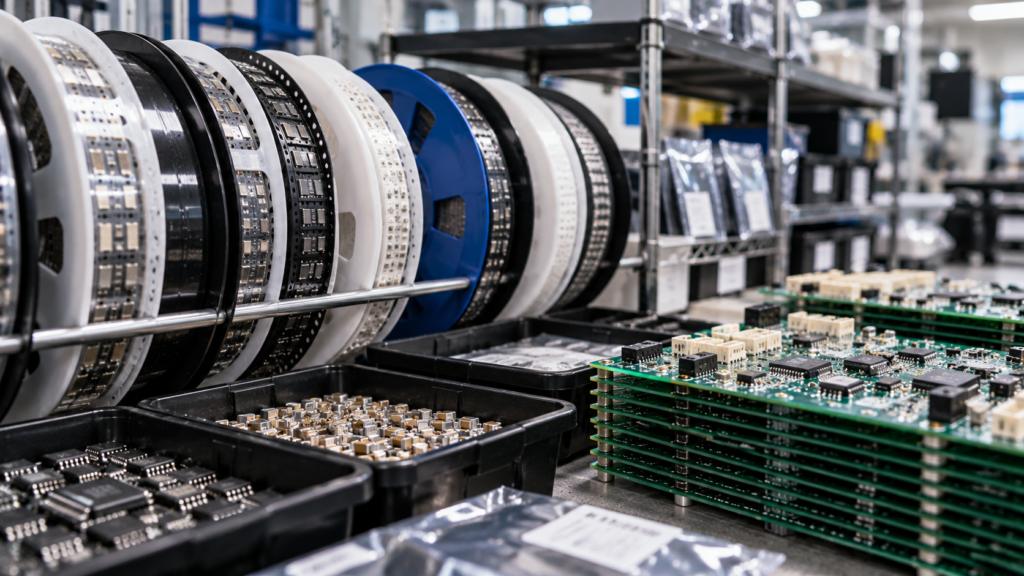
Electronic component availability plays a critical role in modern manufacturing. For OEMs, engineers, and procurement teams, even a single unavailable component can delay an entire printed circuit board assembly (PCBA), disrupt production schedules, and increase costs.
As electronic products become more complex, managing component lead times requires more than simply placing purchase orders. Successful production planning depends on understanding supplier capacity, component lifecycles, approved alternatives, inventory requirements, and potential supply chain disruptions.
By developing a proactive sourcing strategy, manufacturers can reduce uncertainty and improve their ability to meet customer delivery commitments.
Understanding Electronic Component Lead Times
An electronic component lead time is the period between placing an order and receiving the required components.
Lead times vary depending on component type, manufacturer capacity, distributor inventory, order quantity, and market demand.
Common electronic components include:
- Microcontrollers and processors
- Integrated circuits (ICs)
- Capacitors and resistors
- Connectors and interconnects
- Power management components
- Sensors and communication devices
- Semiconductors and memory devices
Some standard components may be readily available through authorized distribution channels. Others, particularly specialized or application-specific devices, may require extended manufacturing lead times.
It is important to distinguish between published lead times and confirmed delivery commitments. A supplier’s quoted lead time may change based on allocation, factory capacity, or order timing.
For production programs, component availability should be verified regularly rather than assumed to remain constant.
1. Identify Supply Chain Risks Early in the Design Process
Supply chain planning should begin during product development, not after the design is finalized.
Engineers often select components based on electrical performance, physical dimensions, and functionality. However, availability and lifecycle status can be equally important to long-term production success.
Before approving a component, consider:
- Current availability through authorized distributors
- Manufacturer production lead time
- Component lifecycle status
- Availability of approved alternatives
- Minimum order quantities (MOQs)
- Expected annual usage
- Geographic or supplier concentration risks
A component that performs well technically but has limited availability may introduce unnecessary risk into the finished product.
Early collaboration between engineering, purchasing, and manufacturing teams can help prevent sourcing problems before production begins.
2. Maintain an Accurate and Complete Bill of Materials
The bill of materials (BOM) is one of the most important documents in electronic manufacturing.
An accurate BOM helps purchasing teams identify required materials, compare supplier availability, and plan component procurement.
A well-maintained BOM should include:
- Manufacturer part numbers
- Component descriptions
- Required quantities per assembly
- Approved manufacturers and alternatives
- Reference designators
- Applicable component revisions
- Lifecycle and availability information, where available
Incomplete or outdated BOM information can result in purchasing delays, incorrect substitutions, or production interruptions.
For example, a component listed without a complete manufacturer part number may require additional engineering clarification before procurement can begin.
Maintaining revision control is also essential. When engineering changes occur, the BOM, assembly drawings, and purchasing requirements should be updated together.
3. Develop Approved Alternate Component Strategies
One way to reduce sourcing risk is to identify alternate components before shortages occur.
An approved alternate may provide equivalent functionality while offering better availability or a more reliable supply source.
However, component substitutions must be reviewed carefully.
Potential differences include:
- Electrical specifications
- Package dimensions and pin configurations
- Operating temperature ranges
- Voltage and current ratings
- Firmware or software compatibility
- Regulatory and customer approval requirements
A component that appears similar in a distributor catalog may not be suitable for direct substitution.
Engineering approval and, when necessary, validation testing should be completed before an alternate component is released for production.
For critical components, developing an approved vendor list or approved manufacturer list can help purchasing teams respond more quickly when availability changes.
4. Improve Forecasting and Production Planning
Accurate demand forecasts help suppliers and manufacturing partners prepare for future production requirements.
When purchasing teams provide only short-term demand, suppliers may have limited opportunities to reserve inventory or schedule manufacturing capacity.
Longer-term forecasts can support:
- Component procurement planning
- Supplier capacity discussions
- Inventory allocation
- Production scheduling
- Pricing negotiations
- Identification of future shortages
For example, an OEM expecting a consistent monthly production requirement may benefit from sharing a rolling forecast with its manufacturing partner.
This allows both parties to evaluate material needs before shortages affect the production line.
Forecasts should be reviewed and updated regularly as customer demand changes.
5. Evaluate Inventory and Purchasing Strategies
Different purchasing strategies can help manage component availability.
The appropriate approach depends on demand stability, component cost, lead time, and inventory risk.
Blanket Purchase Orders
Blanket purchase orders may allow an OEM to establish purchasing requirements over a defined period, with scheduled releases or deliveries.
This can support longer-term planning, although the commercial terms and supplier commitments must be clearly established.
Safety Stock
Safety stock provides additional inventory to help protect against unexpected demand increases or supply delays.
The required amount should be based on demand variability, replenishment lead time, and acceptable service levels.
Scheduled Material Releases
Scheduled releases help coordinate component deliveries with production requirements.
This approach may reduce unnecessary inventory while maintaining visibility into future demand.
Strategic Component Purchases
For selected long-lead-time or high-risk components, purchasing material ahead of immediate production needs may be appropriate.
However, early purchases can introduce risks related to design changes, excess inventory, storage conditions, and component obsolescence.
Inventory strategies should balance continuity of supply with financial and operational considerations.
6. Monitor Component Lifecycle and Obsolescence
Electronic components do not remain in production indefinitely.
Manufacturers may discontinue products because of technology changes, declining demand, manufacturing transitions, or product portfolio decisions.
When a component approaches end of life, OEMs may need to evaluate replacement options or make a final purchase.
Important lifecycle considerations include:
- Product change notifications (PCNs)
- End-of-life (EOL) notices
- Last-time-buy deadlines
- Approved replacement components
- Redesign requirements
- Remaining product support life
A last-time-buy decision should account for expected future demand, product service requirements, inventory carrying costs, and the possibility of design changes.
For long-life industrial products, component lifecycle management is particularly important because finished equipment may remain in service for many years.
7. Reduce Counterfeit and Unauthorized Sourcing Risks
When components become difficult to obtain, purchasing teams may consider alternative suppliers.
However, buying from unfamiliar or unauthorized sources can introduce quality and traceability risks.
Potential problems include counterfeit components, improperly stored materials, incorrect part markings, or components with an unknown handling history.
Risk reduction measures may include:
- Prioritizing original manufacturers and authorized distributors
- Reviewing supplier qualifications
- Maintaining purchasing and lot traceability
- Requesting appropriate documentation
- Using risk-based inspection and testing
- Following customer-specific sourcing requirements
When independent distribution is necessary, additional verification may be required depending on the application and component risk.
For aerospace, defense, medical, and other regulated applications, sourcing controls should align with applicable customer and contractual requirements.
8. Strengthen Communication Between Engineering, Procurement, and Manufacturing
Component shortages often become more difficult to manage when teams operate independently.
Engineering may be focused on technical performance, purchasing on price and availability, and manufacturing on production schedules.
A coordinated approach helps teams evaluate the full impact of sourcing decisions.
Regular communication should address:
- Material shortages and potential delays
- Engineering change orders (ECOs)
- Approved component substitutions
- Production priorities
- Inventory availability
- Supplier delivery commitments
- Upcoming demand changes
For example, when a long-lead-time component becomes unavailable, engineering and procurement may need to evaluate alternatives while manufacturing determines the effect on scheduled production.
Clear communication helps prevent unnecessary delays and supports more informed decisions.
9. How Trident Industries Supports Electronic Manufacturing Supply Chains
At Trident Industries, we understand that reliable component sourcing is an important part of successful PCB assembly and electronic manufacturing programs.
Through our network of manufacturing partners, we support OEMs and procurement teams with:
- PCB assembly sourcing and production coordination
- Bill of materials and component availability discussions
- Supplier communication and quotation coordination
- Prototype-to-production planning
- Manufacturing requirements and scheduling
- Cable and wire harness assemblies
- Integration and box build requirements
Our role is to help customers connect their technical requirements with manufacturing resources suited to their projects.
By coordinating with manufacturing partners and supporting communication throughout the sourcing process, we aim to help customers identify potential challenges early and improve production planning.
Building a More Resilient Electronic Component Supply Chain
Electronic component shortages and long lead times can create significant challenges for OEMs, but proactive planning can help reduce their impact.
Maintaining accurate BOMs, identifying approved alternatives, monitoring component lifecycles, sharing demand forecasts, and working closely with manufacturing partners can all contribute to a more resilient supply chain.
The goal is not simply to find available components. It is to establish a sourcing strategy that supports product quality, production continuity, and long-term business requirements.
Discuss Your Electronic Manufacturing Requirements
Are component availability, production planning, or supplier coordination affecting your PCB assembly program?
Contact Trident Industries to discuss your project requirements, production quantities, and sourcing challenges. We can help coordinate a review with manufacturing partners suited to your electronic manufacturing needs.