
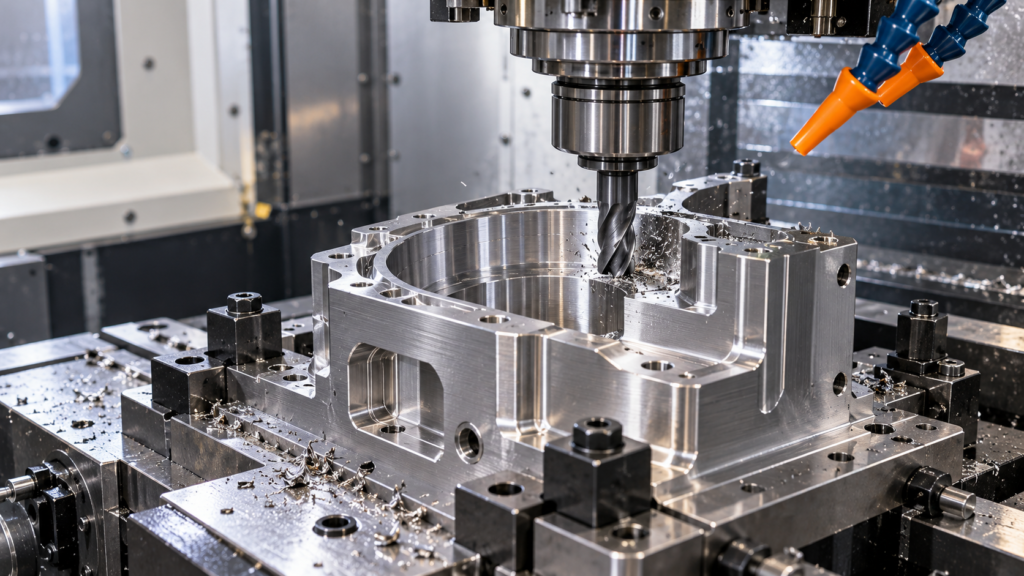
Choosing the right manufacturing process can make a significant difference in the cost, quality, performance, and delivery of a component. For OEMs, engineers, and procurement teams, deciding between CNC machining, casting, and forging is often an important step in moving a design into production.
Each process offers different advantages depending on the material, part geometry, production volume, mechanical requirements, and budget. Understanding these differences early can help manufacturers avoid unnecessary tooling costs, reduce lead times, and improve long-term production efficiency.
Understanding the Three Manufacturing Processes
CNC Machining
CNC (Computer Numerical Control) machining uses computer-controlled equipment to remove material from a solid piece of metal or another machinable material. Common operations include milling, turning, drilling, and threading.
CNC machining is widely used for prototypes, precision components, and production parts that require tight dimensional control.
Common applications include:
- Precision housings and enclosures
- Mounting brackets and structural components
- Valve components and fittings
- Custom mechanical parts
- Aerospace and industrial equipment components
CNC machining is particularly useful when design flexibility, precision, or low initial tooling investment is important.
Casting
Casting involves pouring molten metal into a mold and allowing it to solidify into the desired shape. Depending on the application, manufacturers may use sand casting, investment casting, die casting, or other methods.
Casting can produce complex shapes that would require extensive material removal if manufactured entirely through machining.
Common applications include:
- Pump and valve bodies
- Industrial housings
- Equipment frames and brackets
- Complex enclosures
- Fluid-handling components
Cast parts often require secondary CNC machining to achieve critical dimensions, sealing surfaces, or threaded features.
Forging
Forging shapes metal through compressive force, often using dies and presses. Depending on the material and process, forging may be performed hot, warm, or cold.
Forging can improve grain flow and produce components with favorable mechanical properties when the process and material are properly engineered.
Common applications include:
- High-load mechanical components
- Shafts and connecting parts
- Industrial fittings
- Aerospace and transportation components
- Parts exposed to repeated mechanical stress
Forged components may also require secondary machining to meet final dimensional and surface-finish requirements.
CNC Machining vs. Casting vs. Forging: Key Differences
Although all three processes can produce reliable industrial components, their cost structures and manufacturing capabilities differ.
| Consideration | CNC Machining | Casting | Forging |
|---|---|---|---|
| Initial tooling investment | Usually low | Varies; can be significant | Often significant for dedicated dies |
| Design complexity | Strong for accessible machined features | Strong for complex shapes and internal cavities | Depends on die design and material flow |
| Dimensional accuracy | Can achieve high precision | Often needs finish machining | Often needs finish machining |
| Material efficiency | Can create substantial scrap | Often efficient for near-net shapes | Can be efficient for suitable near-net shapes |
| Production volume | Flexible from prototypes to production | Often attractive for repeat production | Often attractive for repeat production |
| Mechanical performance | Depends on stock material and design | Depends on alloy, process, and quality | Can offer advantageous grain flow and properties |
| Lead time | Often shorter without dedicated tooling | Tooling and process development may add time | Die design and development may add time |
These comparisons are general. Actual results depend on part size, geometry, alloy, tolerances, tooling strategy, supplier capability, and order quantities.
1. Consider Production Volume and Total Cost
One of the first questions to ask is how many parts will be required.
For prototypes and lower-volume production, CNC machining is often attractive because it usually does not require dedicated molds or forging dies. Design changes can also be easier to accommodate.
As production volumes increase, casting or forging may become more economical, particularly when a near-net-shape process reduces machining time and material waste.
However, the lowest unit price does not always represent the lowest total cost.
Procurement teams should evaluate:
- Tooling and setup expenses
- Raw material costs
- Machining and finishing operations
- Scrap rates and production yields
- Inspection and testing requirements
- Freight and logistics
- Inventory commitments
- Tool maintenance and replacement
A proper cost comparison should account for both initial investment and expected production demand.
2. Evaluate Part Geometry and Design Requirements
Part geometry often plays a major role in process selection.
CNC machining works well for components with features that cutting tools can access. Deep internal passages, complicated cavities, or large amounts of material removal may make machining less efficient.
Casting can offer advantages for complex shapes, including certain internal cavities and integrated features. However, draft angles, wall thickness, shrinkage, and mold design must be considered.
Forging is often appropriate for components requiring favorable material flow and mechanical performance. The geometry must still be suitable for the forging process, including die access and material movement.
In some cases, the most effective solution combines processes. For example, a valve body may be cast or forged and then CNC machined to produce precise sealing surfaces and threaded connections.
3. Understand Material Strength and Performance
Mechanical performance is another important consideration.
CNC machining removes material from stock that already has properties established by its original manufacturing process. Those properties depend on the material specification, heat treatment, and stock form.
Casting provides flexibility in material selection and geometry, but quality must be managed carefully. Depending on the casting method and application, defects such as porosity, shrinkage, or inclusions may affect performance.
Forging can produce beneficial grain flow and mechanical characteristics, making it suitable for certain highly loaded or fatigue-sensitive applications.
However, forging is not automatically the strongest choice for every part. Material grade, heat treatment, design, manufacturing controls, and inspection requirements all influence final performance.
For safety-critical applications, process selection should be supported by engineering analysis and applicable specifications.
4. Compare Lead Times and Production Readiness
Lead time can influence the manufacturing decision as much as price.
CNC machining may offer a faster route for prototypes or initial production because it generally avoids the development of dedicated casting molds or forging dies.
Casting and forging can require additional time for tooling design, manufacturing trials, sample inspection, and process approval.
Once a process is established, however, casting or forging may provide advantages for repeat production.
Before selecting a supplier, confirm:
- Tooling development schedule
- First article inspection requirements
- Material availability
- Production capacity
- Secondary machining requirements
- Surface finishing or coating needs
- Expected monthly or annual demand
For ongoing programs, capacity planning and supplier communication are essential to maintaining delivery schedules.
5. Account for Quality and Inspection Requirements
Quality expectations should be established before a purchase order is placed.
Depending on the component and application, inspection requirements may include dimensional verification, material certifications, hardness testing, surface-finish inspection, or nondestructive testing.
For castings, additional evaluation may be necessary to identify internal defects or confirm material integrity.
For forgings, requirements may include mechanical-property verification, heat-treatment records, and inspection of critical features.
For CNC-machined components, dimensional inspection and process control are often central to meeting drawing requirements.
OEMs should clearly communicate drawing revisions, tolerances, material specifications, acceptance criteria, and documentation requirements to their manufacturing partners.
6. Consider a Hybrid Manufacturing Approach
The decision does not always have to be CNC machining or casting or forging.
Many industrial components are produced using a combination of processes.
For example:
- A cast housing may be CNC machined to achieve precision mounting surfaces.
- A forged fitting may be machined to add threads and critical sealing features.
- A machined prototype may later transition to a casting-based production process as demand increases.
A hybrid approach can help balance tooling costs, production efficiency, dimensional accuracy, and component performance.
The best strategy often depends on evaluating the complete manufacturing process rather than focusing on one operation.
7. How Trident Industries Supports Precision Manufacturing Projects
At Trident Industries, we help OEMs and procurement teams connect with manufacturing resources suited to their project requirements.
Through our network of manufacturing partners, we support sourcing and coordination for:
- CNC machining and precision components
- Metal casting and forging
- Secondary machining and finishing
- Prototype and production requirements
- Supplier communication and project coordination
- Related manufacturing and assembly needs
Our approach begins with understanding the component’s drawings, material requirements, tolerances, production volumes, and delivery expectations.
We then work with appropriate manufacturing partners to evaluate potential production solutions and support the quoting and sourcing process.
Choosing the Right Process for Your Next Project
CNC machining, casting, and forging each have an important place in industrial manufacturing.
CNC machining offers flexibility and precision, particularly for prototypes and lower-volume production. Casting can provide advantages for complex geometries and repeat production. Forging can be a strong option for components requiring specific mechanical properties and production characteristics.
The right choice depends on the complete set of engineering, cost, quality, and supply chain requirements.
By reviewing these factors early, OEMs can make more informed sourcing decisions and reduce the risk of costly changes later in production.
Discuss Your Precision Manufacturing Requirements
Evaluating a component for CNC machining, casting, or forging?
Contact Trident Industries to discuss your drawings, material specifications, production quantities, and project requirements. We can help coordinate a review with manufacturing partners suited to your application.